In my article, When success stops feeling like success, I explored the possibility that the…

Procrastination: what are we protecting ourselves from?
Emptiness in the boardroom
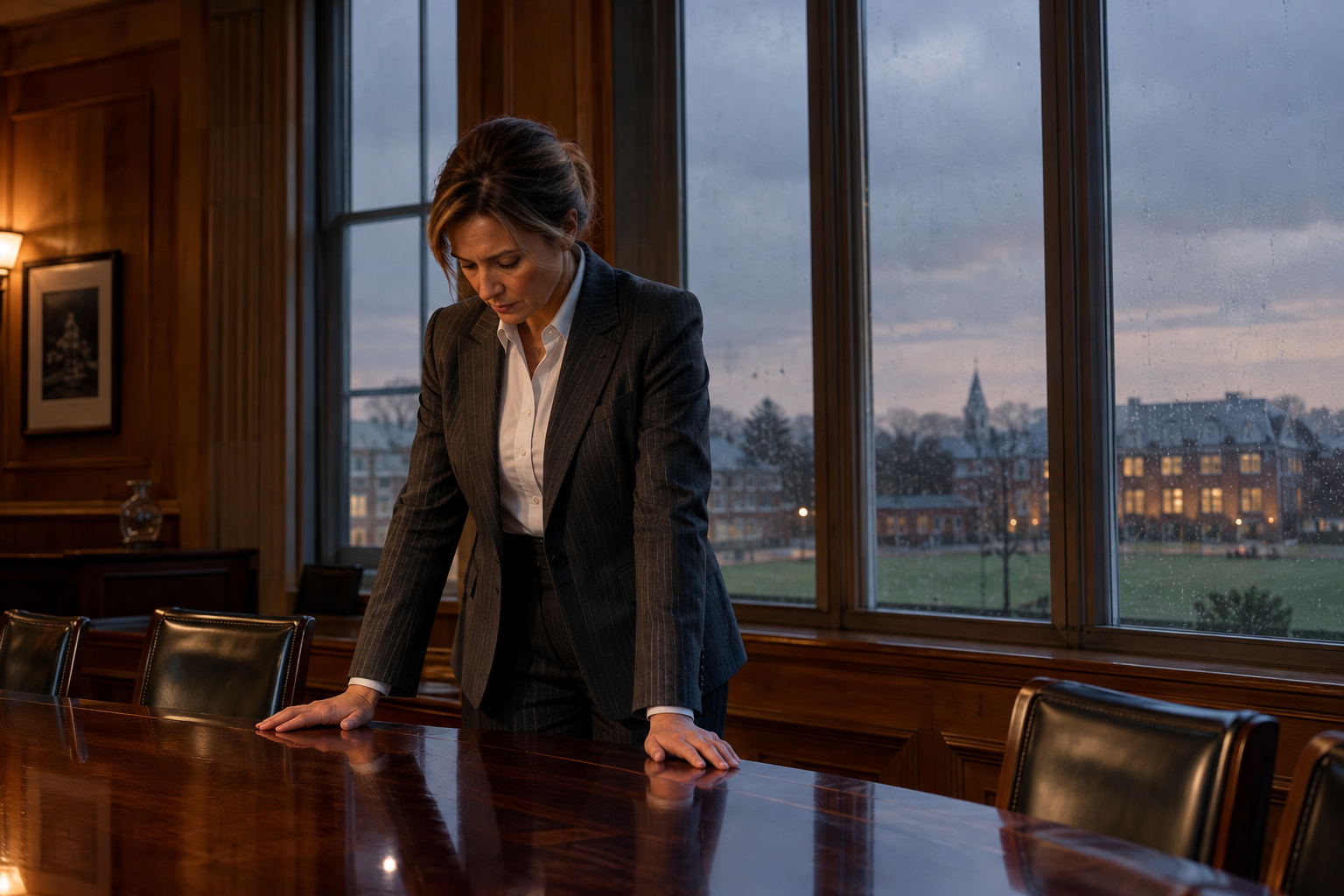
Empty Suit sits at the polished oak board table. The school board meeting is about to start. He’s the multifaceted officer overseeing the school’s finances, estate, operations, and commercial activities. He’s also clerk to the governors, responsible, even now, for the smooth functioning of the meeting and the delivery of papers that will steer an informed and productive debate.
He has set out the table immaculately, papers stacked neatly in front of him. Nobody around that table knows that those papers were only finalised in a blur of panic at two o’clock this morning. They don’t see the weeks spent staring at a blank screen, delaying a start to preparing the papers because the dread of making a mistake felt far heavier than the deadline itself. He is seated to the left of the chairman at the head of the table; the headmaster sits to the chairman’s right. The eighteen governors have arranged themselves around the rest of the table.
He glances furtively around, noticing a few governors inspecting him over their half-rimmed spectacles. He looks down, nervously checking and rechecking his papers without focus. The three hours ahead feel like an eternity. He is certain someone will spot an error in his figures, or that he will freeze when a probing question is thrown his way. And in this moment, he feels numb, like a distant observer of himself, unable to be truly present in the room, as though he is trapped in fear.
Empty Suit feels like an imposter living his own private hell. Yet despite the internal turmoil, the doubts, and the hollow self-esteem, he maintains his professional smile and courteous deference. He wonders how he has miraculously survived this long on such a treacherous, greasy pole.
The terror of getting things wrong, of being found out, is his constant companion. There is no escape, even at night under the duvet, wondering how everyone else managed to land comfortably in flourishing careers and happy lives. All the while, a quiet voice in his head keeps nagging, reminding him of his inadequacies…even now, as he sits at the head of the boardroom table.
That Empty Suit was once me.
The invisible burden: procrastination as a panic response
In the build-up to that boardroom meeting, I had not simply been putting off simple tasks; I had been putting off feeling what doing these tasks might make me feel.
Behind the polished calm, professional pinstripe suit, I had been stalling on papers and avoiding decision-making out of a crippling fear of getting it wrong. It was never laziness, but a learned survival response to a path I never chose.
An endless loop had developed. It wasn’t just in this job. It had developed over the many years since I had been catapulted from my young, carefree days of audits into my first “career role” as a finance director within the NHS. I still remember the unexpected shock of suddenly finding myself, alone, in this senior role, in a cold office in a Victorian mental health institution, a large desk in front of me, a stack of papers to read, the filing cabinet in the corner, some requests in jargon that made no sense to me, and my first meeting ahead where I already felt like an imposter. At that moment, overwhelm truly consumed me. I had not got into that position by stepping through promotional steps where I could have learned the ropes. I had been headhunted and helicoptered into this most senior role because I was a recently qualified chartered accountant. It was a coup for those who recruited me and naivety for me.
And as I sat in that first director’s chair all those years ago, I froze. I remember pushing papers around, half-reading reports, gazing out of the window, making cups of coffee, and speaking to no one as I didn’t want to reveal my vulnerability and my shame.
So, I developed a pattern. I learned how to hide my true feelings, my inner turmoil and my lack of self-identity, and continued with the career steps that I believed were required of me. And here I was, once again, in that familiar moment of freeze. And chronic exhaustion, combined with a form of depression, accompanied this collapsed state.
The pinstripe suit had become an armour of conformity, an outfit chosen to satisfy childhood conditioning, parental expectations and societal “shoulds,” rather than authentic choice.
Procrastination wasn’t simply resistance to the work. It was resistance to the person I believed I had to be in order to do the work.
I wasn’t necessarily avoiding the board papers and the meetings with others, pretending I understood technical issues in an unfamiliar and challenging new environment, or ducking the decisions I was supposed to make.
I was avoiding:
- the possibility of getting things wrong
- the possibility of being exposed
- the shame of discovering I didn’t know enough
- the anxiety of facing something that felt overwhelming
- the imagined judgement of other people.
And procrastinating worked, for a little while.
I pushed the papers away. I made coffee. I looked out of the window.
For a few minutes, I didn’t have to experience that anxiety.
Perhaps what we are avoiding when we procrastinate isn’t always the task itself. Sometimes it is the feeling we anticipate having when we do the task.
Perhaps what underpins it all are the stories we have learned to tell ourselves, carried quietly beneath the surface of our shame:
- “I’m not good enough”
- “I’m not worthy”
- “I can’t cope”
What procrastination is, and what it isn’t
Academic research suggests procrastination may often relate to unstable emotion regulation and avoidance of unpleasant affect. This does not mean procrastination has a single underlying mechanism. In hindsight, I can now see my procrastination was associated with a whole range of uncomfortable emotions attached to a task, such as stress, anxiety, overwhelm, conflict-avoidance, perfectionism, people-pleasing and imposter syndrome.
Left unaddressed, this cycle creates several distinct psychological hurdles:
- The Intention-Action Gap: The painful divide between knowing what you need to do and finding yourself unable to begin.
- Erosion of Volition: The gradual drain of mental energy and self-regulation caused by holding up an external mask of success while battling internal resistance.
- Short-Term Relief vs. Long-Term Cost: Your nervous system prioritising immediate relief from stress over the long-term benefit of completing the work.
What procrastination is really telling us
Most of us procrastinate at some point. For some of us, however, procrastination can become part of a much deeper pattern of avoidance and self-protection.
In my case, that pattern was closely connected with the way I had learned to seek safety through compliance. As a child, I adapted to my environment by becoming “good”, high-achieving and compliant. Over time, I came to associate my sense of worth with external achievement and mistake-free performance.
When the pressure became overwhelming, I could sometimes freeze or dissociate. It was as though I could step away from what was happening rather than fully experience it. Sitting at my desk facing a massive or overwhelming decision, or trying to write a high-stakes board paper, I wasn’t simply struggling to manage my time. At times, I felt unable to begin. My mind and body seemed to be protecting me from the feelings I anticipated: criticism, failure, humiliation or shame.
For me, procrastination was not a character flaw or simply a failure of time management. Procrastination was a line of defence held within an avoidance strategy that my empty suit armour had created to dodge the uncomfortable feelings associated with tackling tasks that might attract criticism, failure, humiliation and shame because of my perceived self-diagnosed incompetence.
Occasionally, procrastination could manifest as a freeze response. When I faced something that felt overwhelming or carried the possibility of failure, I sometimes became quite literally unable to start the task.
I was the child who learned “mistakes bring criticism”; the nervous young man who believes “I must get this right”; the man who faces his imperfection and says “I don’t know if I can get this right”; the man who looks with dread at the tasks ahead and in resignation whispers “I’ll just do it later”; the care-worn man who finally finds solace in distractions and exclaims “ah….relief!” – until midnight arrives….
Stepping out of the suit
By then, procrastination had become such an established pattern that I could not simply ‘willpower’ or ‘time-manage’ my way out of it. My emancipation came with burnout, physical breakdown and the unexpected freedom to choose another roadmap for myself, my rite of passage, and a journey that I ultimately learned was about healing, growth and re-integration. The steps in this journey revealed something transformational in becoming centred through a whole range of mind, body and nervous system techniques. This allowed me to shed the suit that had hidden and protected my emptiness. This gave me the courage I needed to face my vulnerabilities and be kind to the part of me that was desperately scared of repeating those old feelings of imperfection and inadequacy that had created the empty suit in the first place.
The metaphor of the empty suit is about the conformity that suppresses the real person inside.
It is about conformity with patterns that have been set for us to connect with our inner being. It’s about self-compassion over self-criticism. It’s about noticing the pattern without shame and replacing the old inner critic with gentle curiosity. Perhaps we can learn to check in with ourselves in real time: Am I doing this to conform, or because it matters to me? What does my body actually need right now?
The question I ask myself today
And so, as I continue to reflect on myself and my many learnings, I can ask myself, “What do I now understand about that man and his procrastination that I didn’t understand then?”
The next time I catch myself procrastinating, perhaps the question isn’t “Why can’t I make myself do this?” but “What am I afraid I will feel if I do?”
Perhaps then, I can be the curious observer of myself, and kindly ask the questions:
What is happening here?
What did I learn?
What am I still doing because I believe I have to?
Where is the possibility of choice?
I have begun to understand why I came to believe I wasn’t good enough: If Jeremy doesn’t start the paper, he doesn’t have to discover whether Jeremy is capable of writing it.
If he delays the decision, he can temporarily preserve the belief: “I could do it if I really tried.”
Starting creates exposure.
Finishing creates judgement.
Submitting creates the possibility of being wrong.
Procrastination preserves possibility while avoiding reality.
I have found that insight fascinating.
The Empty Suit has to maintain the impression of competence.
So perhaps procrastination isn’t merely avoidance of an unpleasant task.
It can become a way of protecting an identity.
And this could explain why procrastination can be so deeply connected with imposter feelings.
Related Posts